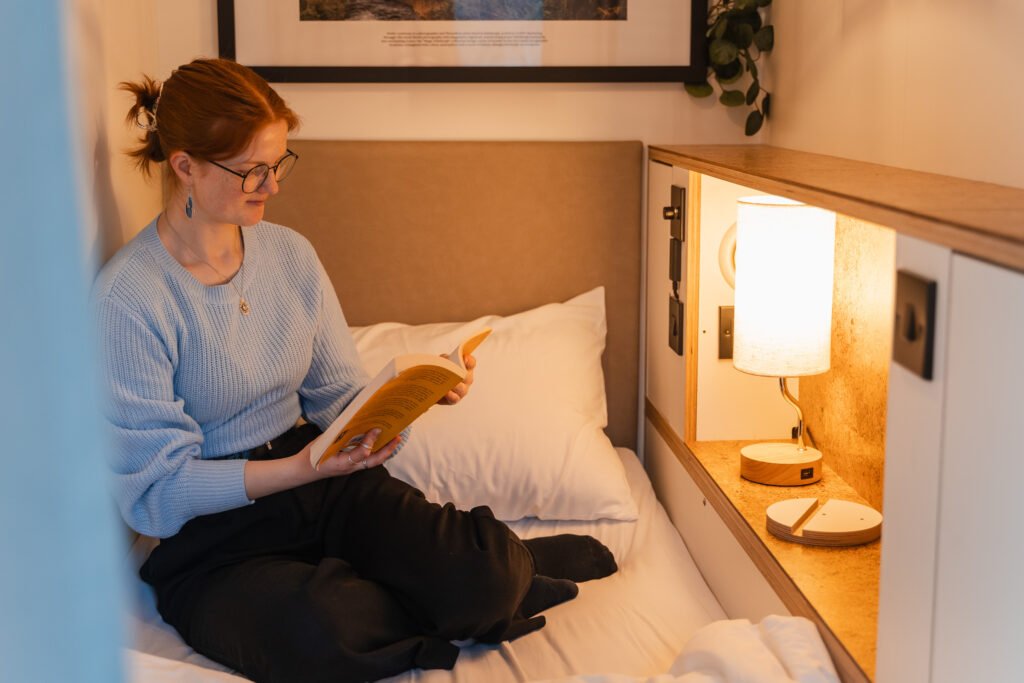
CODE The Loft, a well-established hybrid accommodation provider in the Scottish capital, has reopened its doors following an extensive refurbishment. The establishment is introducing what it claims are the UK’s first full-height Japanese capsule beds, aiming to set a new standard in the evolving hybrid hospitality sector. This launch comes nearly a decade after CODE first pioneered capsule bed accommodation in Edinburgh, having been established in 2014.
The recent overhaul across the property includes significant upgrades, most notably a new penthouse four-bed female-only dormitory, which features exclusive access to a private roof terrace with views overlooking central Edinburgh.
The vision for these advanced capsules emerged from a research trip to Tokyo in 2025 by CODE’s founder and managing director, Andrew Landsburgh, and his team. Their immersion in Japan’s renowned capsule hotels, including establishments like Resol Poshtel and The Millennials, provided a blueprint for enhancing guest comfort and privacy in Edinburgh. Capsule hotels, originating in Osaka, Japan in 1979, were initially designed by architect Kisho Kurokawa as an efficient and affordable solution for urban travellers and salarymen.
“Visiting Tokyo’s capsule hotels was genuinely transformative,” stated Andrew Landsburgh. “We loved the feeling of the full height capsules, it was like having your own small room, private and peaceful, without sacrificing quality or comfort. That trip made it clear that we could bring something truly special back to Edinburgh. These new capsules blend Japanese inspiration with everything we’ve learned from running capsule accommodation for more than a decade.”
The newly designed capsules at The Loft are engineered to offer a spacious and serene micro-room experience. Each capsule is equipped with practical features such as a built-in phone holder for hands-free viewing and an adjustable extract fan for optimal air circulation. Comfort has been a key focus, with bespoke mattresses made from natural, breathable materials for temperature regulation and luxury hypoallergenic duck feather duvets. Advanced acoustic insulation has also been integrated to significantly reduce noise, creating a tranquil environment.
Practicality for the modern traveller was also a central consideration. Each capsule now includes a secure digital locker for valuables and an oversized under-bed storage area with integrated lighting. Guests will also benefit from multiple charging options, including UK three-pin sockets, USB, and USB-C ports.
Jamie Greig, Head of Projects & Design at CODE, who led the detailed development of the project, commented: “We designed these capsules to feel like a true home from home. Every detail came from real experience, staying in capsules of every shape and size over the years and asking ourselves what we always wished they had. From the acoustic insulation to the storage lighting, to the custom mattress and the extra hooks, it’s all about making travel feel easier, calmer and more personal. We’re incredibly proud of what we’ve created.” The aesthetic refinement of the space, including the updated dormitories, was further enhanced by interior designer Pamela Mackay.
Beyond the individual capsules, CODE The Loft’s refurbishment extends to all capsule dormitories and modernised bathrooms. The building’s exterior now features new signage, reflecting CODE’s updated branding introduced late last year.
Market Dynamics: A Burgeoning Hybrid Hospitality Sector
The introduction of these Japanese-inspired capsules by CODE The Loft aligns with significant growth trends in the UK and European hybrid hospitality markets. This sector, which blends accommodation with co-working, event, and community spaces, caters to modern travellers seeking both leisure and business facilities. The “bleisure” phenomenon, where individuals combine business trips with leisure activities, alongside the rise of remote working, continues to fuel demand for flexible and experience-driven lodging.
You Might Also Like:
No related posts.
The European capsule hotel market is projected to grow at a compound annual growth rate (CAGR) of 7.4% between 2024 and 2031. Other analyses forecast a CAGR of 9.6% from 2025 to 2030, with the market reaching an estimated US$64.2 million by 2030. Within this, the UK market is expected to see a CAGR of 6.5% during the 2024-2031 period. The global capsule hotel market, valued at US$75.5 million in 2021, is anticipated to reach US$281.1 million by 2030, growing at a CAGR of 7.1%.
Edinburgh continues to be a highly attractive destination for hotel investment, topping the 2025 Colliers UK Hotel Market Index. The city’s hotels recorded an average occupancy rate of 85% in 2024, demonstrating strong performance with double-digit growth in both Average Daily Rate (ADR) (up 10%) and Revenue Per Available Room (RevPAR) (up 13%) compared to the previous year. Another report indicated an occupancy level of 84.1% and an ADR of £220 for the 12 months ending May 2025. This robust performance underscores Edinburgh’s enduring appeal to both leisure and corporate travellers, supported by its year-round tourism and major events.
While other capsule-style accommodations exist across the UK, CODE’s emphasis on “full-height Japanese capsule beds” highlights a specific design philosophy. Competitors include Yotel, which launched its first “cabin” hotel in 2007 (with the concept dating back to 2004). St Christopher’s at The Village has also offered capsule-style lodging. More recently, Zedwell opened what it claims to be the world’s largest capsule hotel in London’s Piccadilly Circus in October 2025, featuring nearly 1,000 “cocoon-style” pods. Additionally, TARKA Edinburgh is set to open a new Japanese-inspired capsule hotel in summer 2026, featuring pods that are designed for sitting rather than standing. CODE’s focus on replicating the full-height experience found in Japanese models positions it distinctly within this evolving competitive landscape.