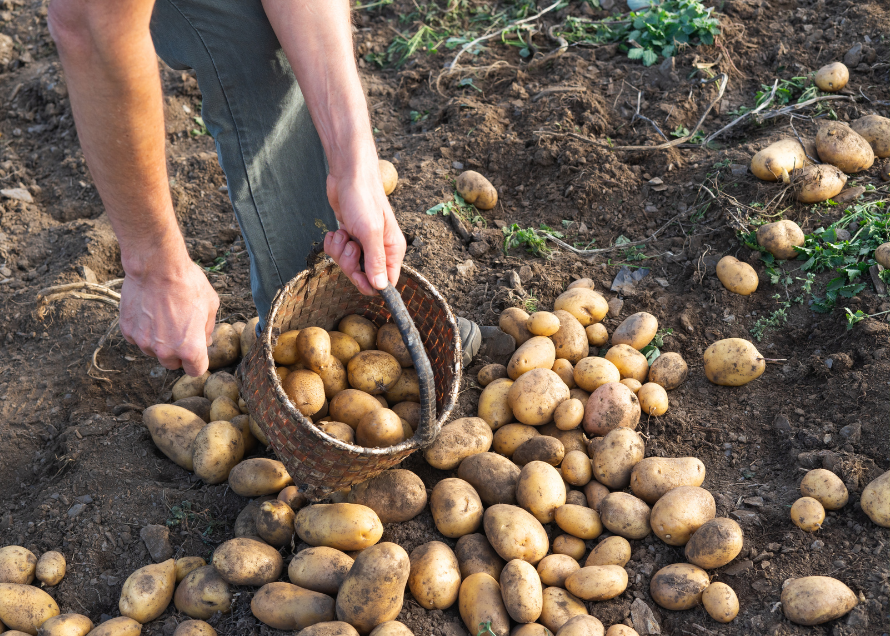
Urgent calls for strategic investment and regulatory reform as extreme weather threatens a cornerstone of British agriculture.
The British potato industry is confronting one of its most severe challenges to date, as growers contend with persistent dry conditions and escalating competition for finite water resources. This mounting pressure has led to warnings that the nation’s food security could be at risk if immediate and long-term solutions are not implemented. The issue gained prominence during the summer of 2022, when more than two-thirds of England and all of Wales were officially declared in drought, a situation that has since recurred with increasing frequency.
The National Farmers’ Union (NFU) has underscored the gravity of the situation. NFU Deputy President Paul Tompkins stated that farmers are now experiencing “climate change in action,” with hotter, drier conditions making food production “more difficult, expensive and uncertain.” He further said: “Water is a vital ingredient in food production, and without a secure supply, we cannot build resilient farm businesses or strengthen the country’s food security.” Scott Walker, CEO of GB Potatoes, echoed these sentiments, asserting: “Water is not an optional extra for potato production. It is fundamental to maintaining the crop we grow today and absolutely essential if we want to increase British production in the future.”
For potato growers, the conversation extends beyond mere water management to the very viability of British food production. “For us, the conversation isn’t really about water at all. It’s about food. It’s about whether British growers can continue producing high-quality potatoes in a climate that has become increasingly unpredictable,” said one grower, highlighting the industry’s vulnerability. “This season has shown just how vulnerable our industry can be when rainfall doesn’t come and irrigation supplies run short. That’s why securing water for agriculture must become a national priority. For me, and many growers across the country, water is the biggest issue facing our businesses right now.”
The financial implications for growers are substantial. Potatoes are an expensive crop to cultivate, with costs ranging from approximately £8,500 to £9,000 per hectare. In contrast, growing cereals costs less than £1,000 per hectare. Without adequate water, the impact is not solely on yield but also on quality, creating difficulties throughout the harvest and storage phases. The Met Office’s analysis indicates that extreme weather events, including droughts, have become more frequent and intense over the past decade, posing a continuous threat to agricultural yields and farmer incomes.
A Strained Resource in a Growing Economy
The East of England, a major potato-producing region including Norfolk where one grower reported less than 50mm of rainfall during planting alongside extreme heat and drying winds, is particularly water-stressed. Here, agricultural demand for water is increasingly competing with the needs of housing, industry, and environmental protection. Water abstraction, the process of taking water from natural sources, is tightly regulated by bodies like the Environment Agency, with licences typically required for volumes exceeding 20 cubic metres per day (20,000 litres). These regulations impose conditions on when and how water can be taken, reflecting growing environmental pressures, especially during dry periods.
The UK potato sector is a significant economic contributor, underpinning more than £4.5 billion of economic activity annually and playing a crucial role in national food security. However, domestic production has seen a decline, with the UK supplying only 71% of its potato demand in 2025, a notable decrease from 90% at the turn of the century. In 2022-2023, total potato production decreased by 6.4% to 5.29 million tonnes compared to the previous year. This decline makes the UK more reliant on imports, including approximately 1 million tonnes of frozen chips annually.
Pathways to Resilience: Investment and Policy Reform
To mitigate these risks, the industry is advocating for substantial investment in water infrastructure and supportive policy frameworks. Collaborative initiatives, such as a reservoir project in Norfolk where several farms have partnered to capture and store winter rainfall for use during the growing season, demonstrate the potential of long-term planning and cooperation.
You Might Also Like:

Growers are calling for support to expand such infrastructure. “The challenge is that reservoir projects require significant investment, lengthy planning processes and confidence that water will be available to fill them over the long term,” the grower explained. “With drought now affecting large parts of the UK, the need for immediate action has never been clearer. Growers need support to invest in water infrastructure, including reservoirs that can capture surplus winter rainfall for use during increasingly dry summers. Grant funding for reservoir development, alongside a more joined-up approach to planning and water licensing, would help unlock the long-term investment needed to protect food production.”
The government has acknowledged these concerns, announcing measures including the reopening of the Water Management Grant, which provides capital grants of between £35,000 and £500,000 for water storage infrastructure, such as on-farm reservoirs. This initiative aims to enhance resilience during dry periods and safeguard crop production. Furthermore, the government has committed to simplifying planning processes for new water storage infrastructure and launched a “Plan for Water” to improve overall water resilience. The NFU is also advocating for more flexible abstraction licences to allow farmers to capture and store water when it is abundant for use during shortages.
While water scarcity is not a new phenomenon, with the NFU noting that the UK is marking 50 years since the severe 1976 drought, recent seasons underscore the urgency for action. “The risk is that once the rain returns, the urgency fades. We can’t afford to let that happen. The focus now must be on future-proofing water supplies for agriculture so that British growers can continue producing food sustainably, competitively and securely for generations to come,” concluded the grower. Without concerted efforts from government, regulators, and the industry, the future of British potato production, and by extension, the nation’s food security, remains uncertain.