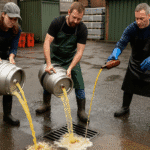
A leading dairy supplier has admitted to having to throw away milk over the Christmas period due to too much supply.
According to The Grocer, dairy wholesaler Freshways told its farmers it had been forced to “physically dispose of milk and this situation is expected to continue into the new year.”
Freshways Managing Director, Bali Nijjar, said “milk supplies have reached record levels” and that it was prepared for “worst-case scenarios.”
“This is a scandal that shows just how wasteful and cruel our food system has become,” says Vegan Society CEO, Libby Peppiatt. “Cows are being milked to their limits in order to produce a commodity that is now so disposable that it is literally being poured down the drain.”
Data from the Agriculture and Horticulture Development Board (AHDB) shows that milk production has risen by 6% since last year.
The oversupply of dairy milk means Freshways has cut prices by an additional 2p per litre from 1 February. This follows price reductions by dairy giants, ARLA and Mueller, which have contributed to several cuts to ‘farmgate’ prices – the average price paid by dairies for all milk purchased each month, which now stands at around 35p per litre, more than 10p per litre lower than a year ago.
“The solution to this problem is not to reduce prices and keep producing more and more dairy milk that consumers clearly don’t want,” says Ms Peppiatt. “That doesn’t help farmers and it certainly doesn’t help cows.
“The answer is for people to stop drinking cows’ milk. The clue is in the name: it’s produced by cows for their calves, not for humans.
“Humans don’t need cows’ milk. The answer is to consume plant milks, which taste great and can be really good for us, as the government’s 2025 Scientific Advisory Committee on Nutrition (SACN) report confirmed. Unsweetened and fortified plant-based dairy alternatives provide a valuable source of calcium, Vitamin D, iodine, Vitamin B12 and other micronutrients, as well as a source of protein in the case of soya milk.
“Unlike dairy milk, plant milks also provide a source of fibre, plus they’re lower in saturated fat and ‘bad’ LDL cholesterol and have a lower total sugar content than dairy.
“They also have lower carbon footprints than dairy milk, generating on average less than one-third of the greenhouse gas emissions of the dairy industry.
You Might Also Like:


“This is a scandalous waste in so many ways,” Ms Peppiatt says, “but fundamentally it highlights the perceived worthlessness of the lives of so many farmed animals.
“Cows are forcibly impregnated, have their calves ripped away for either an early death or a life of their own repeated pregnancies and are themselves then slaughtered when they’re of no further use to our broken food system – all for their milk to be poured down the drain.
“It is an absolute scandal and consumers should be aware of what’s happening – and that there are better, healthier, more ethical plant-based alternatives.”