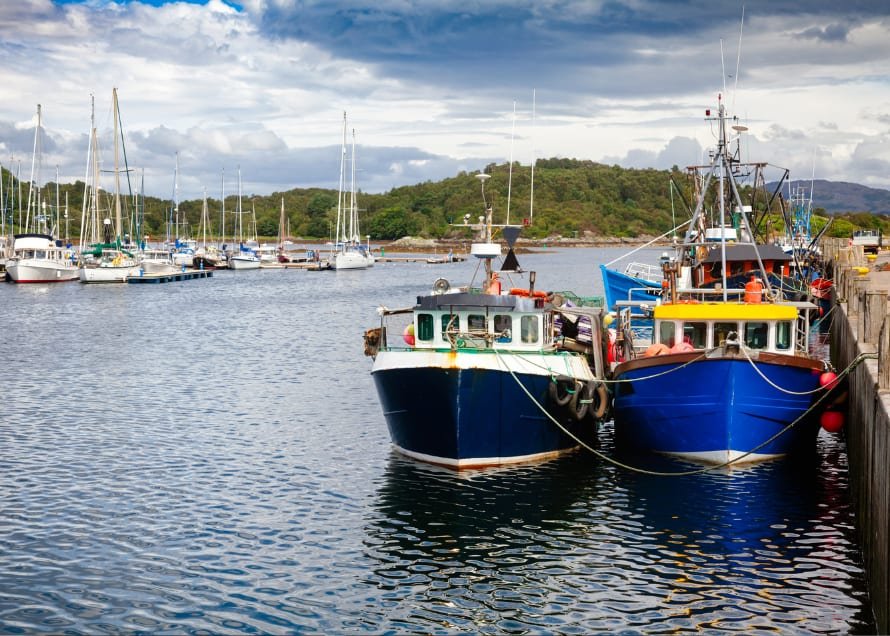
Survey of 1,000 adults commissioned by Scottish Fishermen’s Federation ahead of MPA consultation
More than nine in 10 people believe the Scottish Government must protect jobs, livelihoods and economic growth when making decisions about marine conservation, according to a new opinion poll for the Scottish Fishermen’s Federation. The survey, conducted by Opinion Matters among 1,000 Scottish adults, found that 90.8% agreed with the principle, including 48.8% who strongly agreed. Just 2.1% disagreed.
SFF chief executive Elspeth Macdonald highlighted the findings at the Federation’s annual dinner at The Scotsman Hotel in Edinburgh on Thursday night (5th November), calling for proportionate measures that protect vulnerable marine features while allowing sustainable fishing to continue. The Scottish Government is currently consulting on fisheries management measures for inshore Marine Protected Areas (MPAs) and Priority Marine Features, with potentially significant implications for fishing businesses and coastal communities.
The poll also revealed that 87.4% agreed that well-designed conservation policies can support both environmental protection and sustainable food production. Almost half (45.1%) strongly agreed, while only 1.8% disagreed. An overwhelming 97% considered it important that Scotland continues to catch fish and shellfish from its own waters, including 68.5% who regarded this as very important, with just 3% considering it unimportant. Meanwhile, 87.3% agreed that all forms of food production have some impact on the environment, with only 2.4% disagreeing.
Ms Macdonald said: “These findings show strong public support for conservation policies that also sustain fishing livelihoods and food production. Ministers must give those priorities real weight when deciding how our seas are managed. Scotland’s fishermen depend on healthy seas and sustainable fish stocks. We have worked closely with the Scottish Government and other stakeholders for over a decade to find the right balance between conservation and sustainable harvesting across the MPA network.”
She added: “Support for responsible fishing does not settle the question of which restrictions are necessary. The test must be whether a proposed restriction is needed to achieve a site’s conservation objectives, taking account of the measures already in place and the impact on the people who depend on these waters. MPAs were established on the principle of sustainable use, with a presumption that activities could continue so long as a site’s conservation objectives could be met. We recognise that fishing restrictions may be needed in some MPAs, but they should be designed to protect the feature concerned, rather than imposed as blanket measures across a whole site.”
You Might Also Like:



Ms Macdonald said: “We are encouraged by the detailed analysis supporting the consultation, which shows that in most cases zoned restrictions on demersal fishing gears can achieve conservation objectives while allowing fishing in other parts of the site. Restrictions around Priority Marine Features must also be proportionate to what is needed to protect them, rather than being over-simplified to make a neat shape on a chart. Where existing measures meet conservation objectives, further curtailment of fishing is not justified. Where additional protection is demonstrably needed, measures should be targeted and proportionate. The Scottish Government’s own analysis shows why blanket restrictions should not be the default.”
She continued: “Fishing is a force for good. We produce healthy, nutritious food, provide jobs at sea and ashore, and supply the processors, shops and restaurants that depend on our catches. Our businesses are the lifeblood of many coastal and island communities. All forms of food production have environmental impacts, as almost nine in 10 respondents recognise. The task is to understand and minimise those impacts while sustaining food production. The existence of an impact is not, in itself, a justification for banning an activity. The fact that 97% of respondents consider it important for Scotland to continue catching fish and shellfish from its own waters reinforces just how much the public values our industry. That support must be reflected in the decisions that shape its future.”
The research was conducted among a nationally representative sample of 1,000 Scottish respondents between 21 and 28 October 2026. Opinion Matters follows the Market Research Society Code of Conduct and ESOMAR principles and is a member of the British Polling Council.